Background
LangChain’s Plan-and-Execute framework is inspired by the Plan-and-Solve paper. Plan-and-Execute is well-suited for more complex long-term planning by breaking down complicated problems into smaller sub-tasks and tackling them one by one. Although this involves frequent calls to large models, it avoids the issue of overly long prompts during the ReAct Agent loop.
Plan-and-Solve Strategy
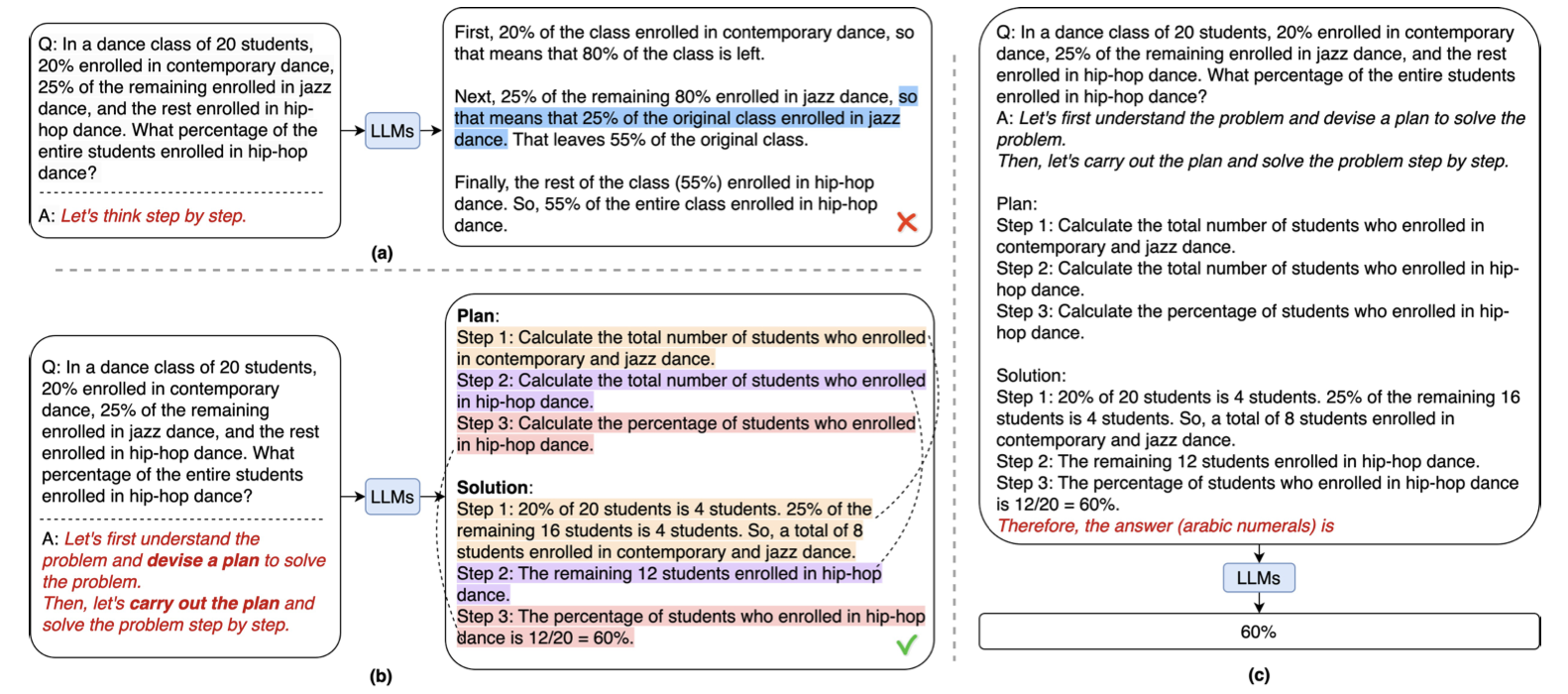
The above diagram compares zero-shot COT and Plan-and-Solve. Essentially, Plan-and-Solve concretizes COT by breaking it into small tasks and then solving these tasks one by one. The Plan-and-Execute framework shares the same philosophy as Plan-and-Solve, but in practice, Plan-and-Execute is more focused on AI practical implementation.
Example Application of Plan-and-Execute Framework
Suitable for Question Rewriting design, multi-agent coordination work, and more.
Scenario: Within a complete AI agent system built on a RAG system.
For example:
Question: Find personal information about Louis and Liu Yifei, then generate a wedding invitation based on their information and send the invitation content to the email worldXXTest@gmail.com.
Plan-and-Execute decomposes the task into: Plan, Execute
Use LLM to break down the question into about 5 Plans:
|-1- Search the database for personal information about Louis
|-2- Search the web for personal information about Liu Yifei
|-3- Search for wedding invitation templates online
|-4- Generate the wedding invitation content for Louis and Liu Yifei
|-5- Send the invitation content to the email worldXXTest@gmail.com
Use the ReAct framework’s LLM to handle these 5 plans one by one in the Execute phase:
|-1- "Louis’s personal info: iOS and AI Engineer, male, good temperament, gentle, kind, humorous..."
|-2- Use the Browser tool, obtain: “Liu Yifei’s personal info: Qianxi, female, film and TV actress, both beauty and talent, likes freedom...”
|-3- Wedding invitation template: “We are getting married. Dear Mr./Ms. xxx, you are welcome to join us on xx/xx/2026 at...”
|-4- Wedding invitation content for Louis and Liu Yifei: “We are getting married. Dear Mr./Ms. xxx, you are welcome to attend our grand wedding on February 31, 2026, at the North Pole Palace on the Moon. We will dispatch the interstellar ship LL001 to pick you up. Please board the ship at midnight on February 30 at the top floor of the Oriental Pearl Tower in Shanghai.”
|-5- Call tool sendMail to send the wedding invitation content
Summary: Call LLM once to generate 5 plans, then call the ReAct Agent 5 times to handle each plan.
Planner Prompt:
prompt = ‘
	You are a task planner in a multi-step AI system.
	User query: {Query}
	Your job:
	1, Break down the user query into executable steps.
	2, Each step must be atomic and tool-executable.
	3, Steps should be ordered logically.
	4, Do NOT execute anything.
	5, Only return JSON.
’
For example:
Query: I want to find someone who holds an English CET-6 certificate and has 3 years of Python development experience. Then send their personal information to luochuanad@gmail.com
The LLM(Planner Prompt) outputs:
json
[
 {
	"step": 1,
	"action": "Search Database",
	"description": "Query the database to find individuals with an English CET-6 certificate 					and 3 years of Python development experience.",
	"parameters": {
		"certificate": "CET-6",
		"experience": {
			"Language": "Python",
			"years": 3
		}
	}
 },
 {
	"step": 2,
	"action": "Retrieve Personal Information",
	"description": "Extract the personal information of the individual(s) found in the 					previous step.",
	"parameters": {
		"fields": ["name", "email", "phone", "address"]
	}
 },
 {
	"step": 3,
	"action": "Format Email",
	"description": "Prepare an email containing the personal information of the individual(s) 					found.",
	"parameters": {
		"recipient": "luochuanad@gmail.com",
		"subject": "Candidate Information",
		"body": "Include the personal information retrieved in step 2."
 	}
 },
 {
 	"step": 4,
	"action": "Send Email",
	"description": "Send the formatted email to the specified email address.",
	"parameters": {
		"recipient": "xxx@gmail.com",
		"content": "Use the email content prepared in step 3."
 	}
 }
]
References
Lei Wang et al.’s paper “Plan-and-Solve Prompting: Improving Zero-Shot Chain-of-Thought Reasoning by Large Language Models” https://aclanthology.org/2023.acl-long.147.pdf
关于作者
我是Louis,一名长期从事iOS与AI相关工程实践的工程师,也是一个正在探索产品与商业可能性的准创始人.
这里的文章,更多是我在项目中用过,踩过坑,反复验证过的东西,而不是为了流量而写的“快内容”.
☕ 打赏
如果这篇文章对你有帮助,欢迎请我喝一杯咖啡☕️
GitHub Sponsors(推荐)You can support my work via PayPay by searching my PayPay ID:
PayPay ID: luochuan


你的支持会让我有更多时间,把真实项目中的经验持续整理和分享出来.
不打赏也完全没关系,感谢你读到这里.
联系与合作
如果你:
· 正在做iOS App / AI / 自动化相关的项目
· 对技术选型、架构设计、产品落地有困惑
· 或希望进行技术交流、合作探讨
欢迎通过以下邮箱联系我:
luochuanad@gmail.com