Background
Without complex RAG design, simply using LlamaIndex’s ReAct RAG Agent framework to analyze financial statements can achieve a level comparable to a junior business analyst. However, there are many limitations. Personally, I think it is only suitable for micro and small enterprises.
Financial Report Analysis Architecture
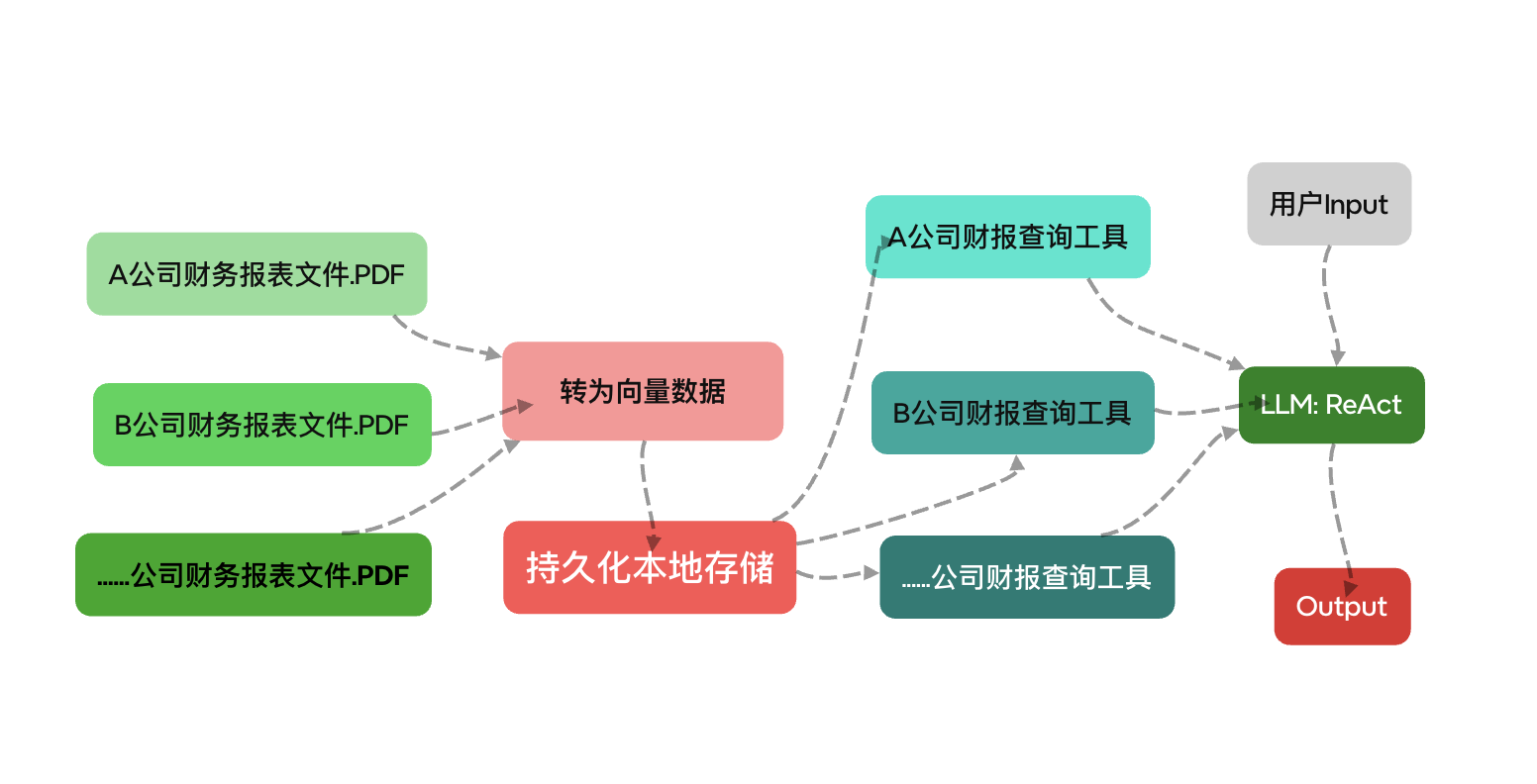
1. Load Financial Report Files for Companies A, B, …
from llama_index.core import SimpleDirectoryReader

A_doc = SimpleDirectoryReader(
	imput_file = ["./A公司财务报表文件_2025.pdf"]
).load_data()

......
2. Build Vector Data Based on Financial Report and Save Locally
from llama_index.core import VectorStoreIndex

A_index = VectorStoreIndex.frome_documents(A_doc)

......

frome llama_index.core import StorageContext

A_index.storage_context.persist(persist_dir="./storage/A")

......
Local Vector Data Directory Structure:
A
|- default_vectory_store.json
|- docstore.json
|- graph_store.json
|- image_vectore_store.json
|- index_store.json
B
|- default_vectory_store.json
|- docstore.json
|- graph_store.json
|- image_vectore_store.json
|- index_store.json

......
3. Configure Query Tools: (A/B/…)
from llama_index.core.tools import QueryEngineerTool, ToolMetadata

query_engineer_tools= [
	QueryEngineerTool(
		query_engineer = A_engineer,
		metadata = ToolMetadata(
			name = "A_finance",
			description= ("Used to provide financial report information for company A"),
		),
	),

	......

]
4. Create LLM: ReAct RAG Agent
from llama_index.core.agent import ReActAgent

agent = ReActAgent.from_tools(query_tools, llm=llm, verbose=True)
Reflection: (ReAct RAG Agent)
Advantages:
1. Only need to provide the company’s financial report files.
2. Simple and fast, leveraging existing LlamaIndex to quickly build a ReAct RAG Agent.
3. The analysis results reach the level of a junior business analyst.

Disadvantages:
1. No detailed RAG process design; performance depends solely on LlamaIndex capabilities.
2. No design for the ReAct process; again, dependent on LlamaIndex itself.
3. No fine-tuning of the large model, so analysis results are limited to junior business analyst level.
4. No human-in-the-loop thinking added, which limits maximizing cognitive synergy: AI + Human.
If the above four drawbacks are addressed, the system could reach the level of a top-tier business analyst. Based on this, I am very optimistic about the future development and application of AI.
Because developing such a system would take at most six months and could embody the expertise of a top business analyst with 20 years of experience. This is humanity’s greatest leverage.
References
Example article source: Hands-on AI Agent by Huang Jia
关于作者
我是Louis,一名长期从事iOS与AI相关工程实践的工程师,也是一个正在探索产品与商业可能性的准创始人.
这里的文章,更多是我在项目中用过,踩过坑,反复验证过的东西,而不是为了流量而写的“快内容”.
☕ 打赏
如果这篇文章对你有帮助,欢迎请我喝一杯咖啡☕️
GitHub Sponsors(推荐)You can support my work via PayPay by searching my PayPay ID:
PayPay ID: luochuan


你的支持会让我有更多时间,把真实项目中的经验持续整理和分享出来.
不打赏也完全没关系,感谢你读到这里.
联系与合作
如果你:
· 正在做iOS App / AI / 自动化相关的项目
· 对技术选型、架构设计、产品落地有困惑
· 或希望进行技术交流、合作探讨
欢迎通过以下邮箱联系我:
luochuanad@gmail.com